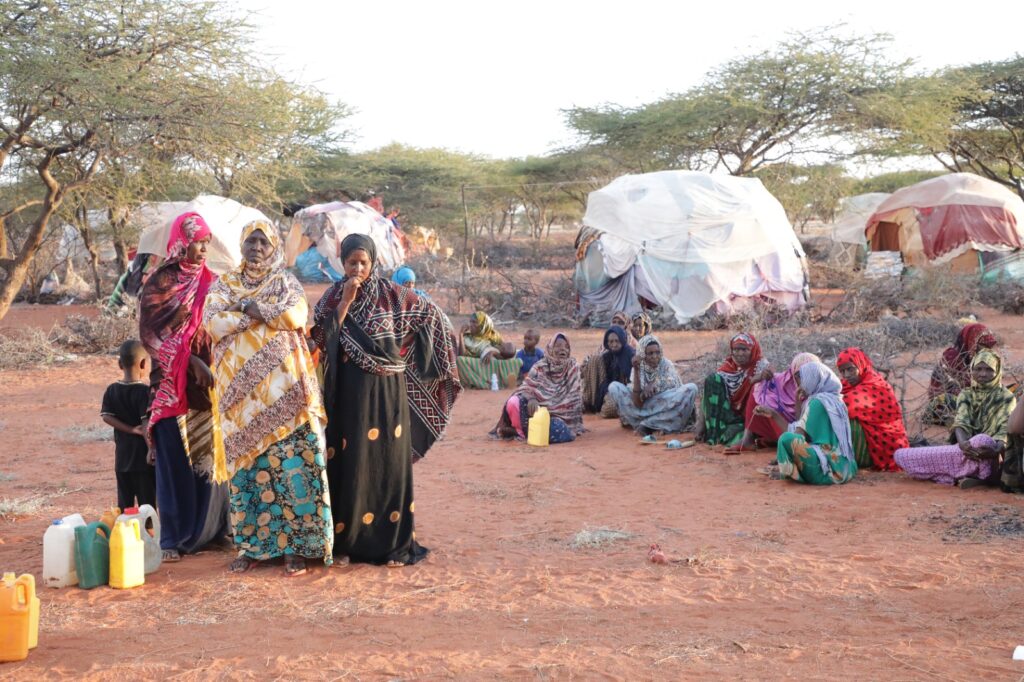
Women and children wait for water distribution at Daryeel Camp in Abudwak,Galmudug
For 34 years, Save Somali Women and Children has worked on protection, peace building and governance in the Horn of Africa. Now a punitive funding gap threatens their work, when nomadic pastoralists’ practices are needed to help stabilise climate change’s global ripple effects.
By James Oliver Swann [Date published]
They come to the camp at night because there is no light. They come from another clan, lingering only as long as it takes to find the woman. The young men, below 25, arrive in twos and threes. The older, lone men, in their 30s and 40s, don’t want witnesses. They know who she is, and where she is, and that she’s alone.
The men appear between 2 pm and 4 pm. Mothers and children lie motionless beneath a solitary acacia tree’s sprawling plane, tormented by the sun and by the wind wailing through a camp built on sand. Their men are away looking for work, or on the rangelands guarding their sheep, goats and camels. A nine-year-old girl, her cleaning finished, strays off to wash at a shared latrine.
Fahma Sharmake gazed out over the camp, in her mid-20s, brown eyes framed by a flowing black garbasaar. Tents, coloured red or white, sprawl across the land. The families who can get hold of iron sheets place them over their tents, protected from the wind, until the heat becomes unbearable. Here, women and girls face rape and murder in the semi-arid savannas, desert plains and shrublands in Galmudug State, central Somalia, where gazelles roam. “How can a girl survive here?” she thought. “This place has no security, and the next police station is miles away. Am I safe?”
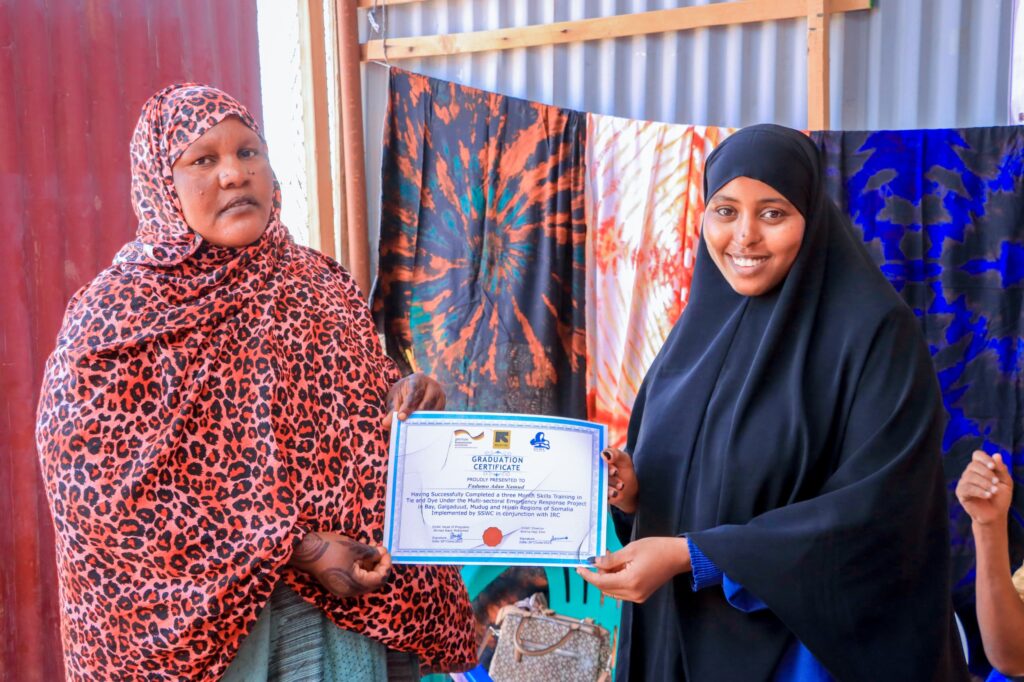
Fahma giving a certicate to a skills training graduate
At the camp, Fahma is a Project Manager and an expert in psychosocial support with Save Somali Women and Children (SSWC). She and her team worked from 2023 – 2025 with government, clan men and local communities at camps for internally displaced people (IDPs), establishing Women and Girl Safe Spaces (WGSS). A crippling funding gap has forced hard choices over where to place scarce safe centres in the Somali Republic’s federal states. Yet in this region, bridging the Indian Ocean to the east and Ethiopia to the west, women and young girls are gradually claiming their power in the country they’re reshaping. These spaces, she said, provide psychosocial needs, education, basic income, reproductive health, child support and reunion with communities.
Somali society, organised around clans, is slowly rebuilding. A civil war lasted from 1991 to 2006, when Ethiopia invaded the Horn of Africa nation to oust the Islamic Courts Union. The resistance and resentment swelled the ranks of a militant insurgency known as Al-Shabaab. Nearly a quarter of Somalis, along with their herds and seasonal pastures, are wasted by droughts exacerbated by the climate catastrophe. They remain haunted by a colonial legacy that favoured one clan over another and drew regional borders. Almost 40% of Somalis are affected by shocks. The violence experienced by men has led to pervasive sexual brutality towards women and young girls. The state remains fragile. Al-Shabaab lives off despair. Yet this is a country where you increasingly hear female voices, changing attitudes and inclusive grassroots initiatives.
Three quarters of Somalis are under 30, which reflects the rise of tech-savvy young people across Africa with their own ideas on the future they’re building. “Social media is key”, said Fahma. “A young person will prefer missing meals to missing the internet.” Africa’s youth use virtual marketplaces, livestreams and short-form videos to test online enterprises, voice their collective distrust of old political structures and share new visions of the future. Youth of all backgrounds, Fahma said, collectively call out wrongdoing. These digital conversations spread solidarity through hashtags and memes from Nigeria to the Horn of Africa, or Egypt.
Close to 60% of the Somali Republic’s 19.3 million people are pastoralists. East Africa’s specialised transhumant economy supplies 90% of meat to a region made up of 70% drylands. In barely 10 years, the number of people experiencing critical food insecurity in Sudan, South Sudan, Uganda, Kenya and Somalia has tripled to over 40 million, reports the Intergovernmental Authority on Development (IGAD), in Djibouti. If climate change mitigation fails here, the spectre of three primary global ripple effects emerges: catastrophic food and economic insecurity; large-scale displacement and migration; widespread conflict and geopolitical instability.
These conditions weaken immune systems and create epidemic-vulnerable environments among affected communities. They overwhelm public health infrastructure and compromise the ability to spot emerging diseases that know no borders.
Somali nomads have played a central role in Western Indian Ocean trade from 1st century BCE onwards, a paper by the Spanish Archaeological Project in Somaliland, and Somali archaeologist, Ahmed Jama Dualeh, shows. Northern coastal sites at Xiis and Berbera, studied between 2015 and 2020, reveal the nomads’ high purchasing power. Today they are a major livestock exporter to the Gulf. Nomadic pastoralisms’ traditional practices connect landscapes through herd migration routes, sustain diverse grassland vegetation and the soil’s water-holding capacity. “Invisible against the sand and rocks” wrote Polish reporter Ryszard Kapuściński, in The Shadow of the Sun, [their tracks are] “etched in the memory of people who have wandered these regions for centuries”. They steward a genetic reservoir of drought-tolerant, disease-resistant and climate-adapted breeds.
The Somali clan structure has been pastoralism’s social organiser for hundreds of years. Now this society scrambles to keep its foothold on a way of life. Drought tears through the rangelands, depleting pastures and wells; Al-Shabaab violently blockades communities and international borders prevents nomadic herders’ mobility. Herds concentrate on degraded grasslands; water runs out. Tribal affiliations that had lived in delicate centuries-old balance, moving to avoid dry season conflicts wherever possible, find themselves thrown together in a struggle of life or death. But the most immediate need is money.
Somalia received over 90% of a $2.3B United Nations (UN) goal in 2022, according to the UN Office for the Coordination of Humanitarian Affairs (OCHA). When US president Donald Trump returned to the White House in January 2025, his administration unilaterally ended USAID funding, which was the UN system’s single most critical source. By December 2025, the UN had secured 28% of a scaled-back $1.4B goal for the East African state. The multilateral organisation will barely reach 25% of the population in 2026. Where will this lead? Could China, Gulf states, or Russia have their own views on this void in soft power on the Gulf of Aden, a crucial waterway connecting the Indian Ocean, the Red Sea and the Suez Canal.
Managed decline and forced priorities characterise this fiscal reality. Some fear the Horn of Africa could become a “neglected conflict”. It would be a strategic mistake. Political realism holds hard power as the prime shaper of alliances, but to be effective, it must have a moral dimension. Global and regional powers providing Somalia with adequate long-term financing is more than a moral act: it is a critical investment in mitigating the climate crisis, public health and global systemic stability. SSWC works on the frontline where change happens.
Save Somali Women and Children is a women-led, non-government organisation (NGO), founded in 1992, in the port capital of Mogadishu. Asha Hagi Elmi is their chairlady and co-founder. She and other women leaders established the all-women Sixth Clan, which played a core role in securing their influence over the Arta peace process in 2000. Business interests, warring parties and regional powers brought the settlement down, but its early successes shifted the discourse to inclusive peace building and governance. It earned her the Right Livelihood Award (December 2008, in Stockholm, Sweden) called the Alternative Nobel Prize. Today 197 people, over 60% of whom are female, work in field offices across every federal state. Their international partners include Dutch Relief Alliance (DRA), Irish Aid and UNICEF. Nationally, the organisation is the Somalia member of the influential Global Partnership for the Prevention of Armed Conflict (GPPAC), carrying out their joint program. This has resulted in a new Somali Peace Building Network, funded by GPPAC, bringing together 10 NGOs from across civil society.
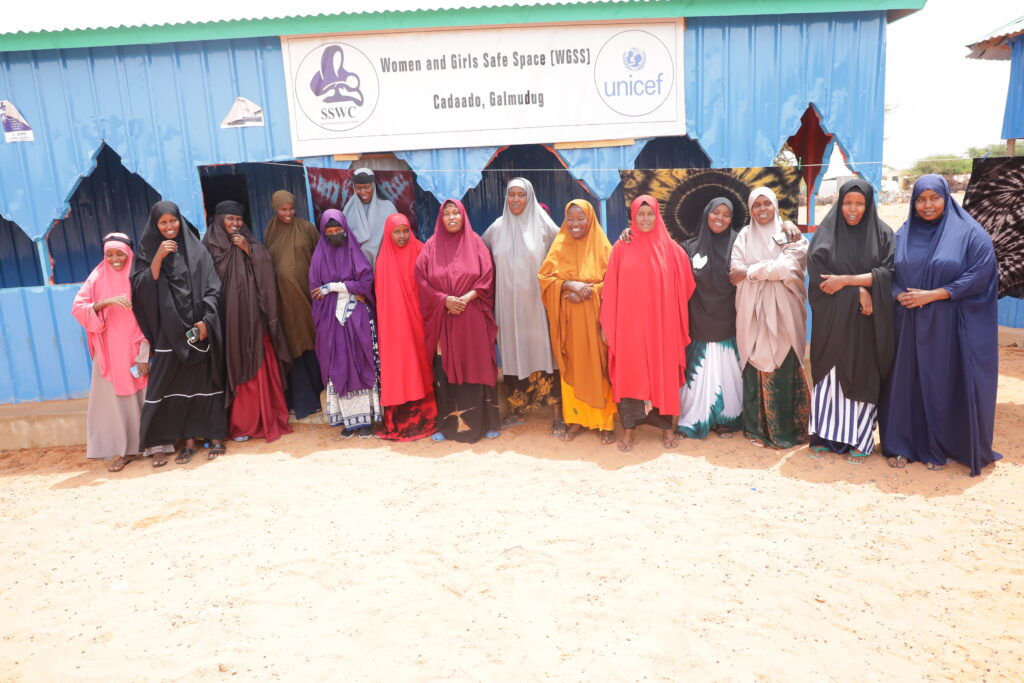
Women and girls at Adado WGSS
Abdirizak Rashid is SSWC’s Monitoring and Evaluation Coordinator, in his early forties, with close-cut smoky black hair and beard. USAID’s abrupt end hit the existing WGSS education and peace building programs hard, he said. The 2026 budget is $10 million; they face a gap of $5 million. This year they plan on reaching 50, 000 adult women and children. This includes 14 safe spaces protecting 5000 people. Every year, they train over 1000 young girls in policy dialogue and community leadership. However, punishingly restricted funding constrains their work’s larger potential, e.g., across areas controlled by Al-Shabaab where international organisations aren’t present.
The militant group preys on ruin. They seize water sources, deliver disaster relief and quasi-judicial services in places the state cannot. Thus, the most effective response could be climate adaptation and inclusive local governance. Societally, shared interests, such as seed banks or water catchments, could support environmental peace building between clans. In the same way, could key herder, agro-pastoral and trade sectors strike commercial agreements to manage climate risks? Nevertheless, a climate-resilient dryland economy ultimately depends on nomads being able to move. The IGAD Protocol on Transhumance, pending ratification, lays out a possible pathway, a critical common interest, between Djibouti, Eritrea, Ethiopia, Sudan, South Sudan, Uganda, Kenya and Somalia in seasonal grazing across international borders.
Among the Somali Republic East African state’s kinship networks, “women generally have relations beyond men”, said Halima Ali Awale. She is wearing cat-eyeglasses, in her early thirties, and the former Director of Gender at the Ministry of Women and Human Rights in Galmudug. You could be from one clan-based community but married into another.
When negotiating conflicts, they look at all affected sides, she continued, stressing these perspectives during meetings. Female influence is emerging in other ways too. A woman from Adado, an inland town, went looking for her animals after losing them during a conflict, Halima said. Men from the opposing group caught her. They didn’t assault her, but taunted her and recorded it. Then they released the recording, only to get a backlash from the women of their own clan.
Evacuating areas due to drought and floods, fleeing from fighting and separating from their men of their clan exposes women and young girls to rape and sexual brutality. “Everybody fears that”, said Halima. Especially, in IDP camps, where IGAD reports that at least 17% of Somalis are in shelters. The men remain guarding their possessions and their herd or must flee when targeted. Mostly, support for people who suffer atrocities comes from civil society organisations, she said. They create protocols, strengthen pathways and work with the government on new laws. Two initiatives SSWC is pursuing include enacting a sexual offences bill into law and a bill preventing adolescent girls from being forced to marry. Bills take a long time to pass but have brought results. “The Ministry of Women passed the prohibition of female genital mutilation [in 2024], which was a complex law”, said Halima. “Galmudug was the first state to pass it in Somalia and end a harmful practice”.
That same year SSWC and the Ministry created the Ileys Women Network in Galmudug. Fifteen-year-old girls to 50-year-old women travel across savannas and scrubland, mediating conflicts based on dialogue, peace messages and gender rights, said Sadia Osman Abtidoon. Ileys’ chairlady is in her early forties, dressed in cyan-blue. Over two weeks in October 2025, before they could act, before they could send their envoys, before they could meet with clan elders, four women were murdered, and a three-year-old girl was raped. “If they have lost a wife or daughter”, said Sadia, “they take a wife or daughter”. After they have lived through rape or other atrocities, Ileys informs the Ministry, which then brings them to the hospital for psychosocial support in Dhusamareb, the state’s inland capital. Some return to their communities within a few days, some in a few months and some never go back. Things have got worse since. Hunger has left pastoralists, together with their goats, sheep and camels, wasted and vulnerable to disease. Clan-based communities turn on one another in a fight to the death over boundaries, pastures and water.
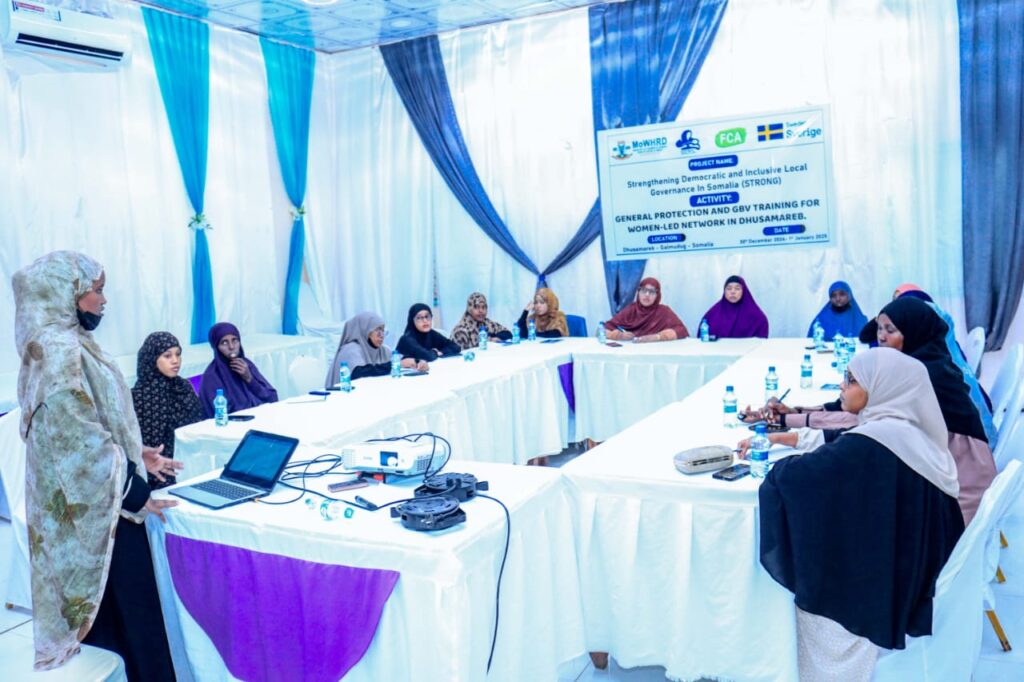
Ileys women group in a discussion.
Ileys means light in Somali. The group’s members have been trained in conflict resolution and local governance, supported by SSWC. Despite these conditions, Sadia sees that the communities who experience local peace building become more integrated and inclusive. Clan elders, some of whom were trained by the NGO when the network was founded, see the change. Elders work with the group on peace and justice. Most men who commit rape are caught, tried and sentenced to five-to-15-year terms.
However, the organisation needs two cars that each cost $70 a day in order to reach these communities. They lack an office at $250 a month so that they can train women-led groups, have network gatherings and hold reconciliation meetings.
The biggest shift is attitudes towards gender rights, which makes education a priority. “The international community is investing in education” said Halima, “even at IDP camps you find schools”. When young people study and build their own responses to shared challenges the draw of conflict will be weaker.
The grassroots-clan-ministerial coordination reveals how Somalis are working to stabilise the Horn of Africa, but global issues require global answers. The youth-driven imperatives of the present, the climate disaster and the forces of history collide in Somalia. International and regional powers face hard choices on who gets money to support rebuilding and renewal. The Arta process revealed you could neither dismiss entrenched power bases, neglect regional concerns nor exclude civil society. This extends to the marginalised and disaffected who make up Al-Shabaab’s rank and file. If greenhouse gas emissions continue at a medium-to-high rate above pre-industrial levels, the Horn of Africa nation will experience up to a 2.3°C temperature increase by 2050. Heat will test Somalia, East Africa and an interconnected world, but no one knows heat like the Somalis. Their millennia-old pastoral practices and specially adapted animal breeds could supply food to the region, help stem human migration and mitigate climate change’s global ripple effects.
It is these societal, economic and ecological spaces where SSWC steadily affects change while protecting women and children. Yet if they are to have WGSS at IDPs across federal states, train fifteen-year-old girls to mediate conflict risking it all on the rangelands and help build climate-adapted local economies—the organization must cover a $5 million gap. “I want every girl to feel safe”, said Fahma. “Free from fear. I’m proud that there’s a generation in Africa where every girl’s voice and feelings are heard.”
With the support of M.I Ali, Communication Officer, Save Somali Women and Children.